Search Results
Search this site
3414 results found with an empty search
- Marilyn Monroe (actor)
Actors Marilyn Monroe (actor) Marilyn Monroe (1926-1962), was an American actress, model, and singer who was famous for playing comedic "blonde bombshell" characters. She grew up in foster care, orphanages and kinship care. By the time she was 7, she'd been moved 7 times. Between the ages of 8 & 12, she had been moved 6 times. Monroe was born Norma Jeane Mortensen and went into care initially as a baby because Gladys, her mother, had postpartum depression (nothing is known of the father). At the age of 8 she returned to live with her mother for a while. Gladys’ friend, Grace McKee, took an interest in Norma Jeane’s welfare. When Gladys was admitted to a psychiatric hospital, Grace became her legal guardian. Both women worked in the movie industry but it was Grace who was particularly keen on the charismatic young Norma Jeane becoming a movie star, thinking she could be the next Jean Harlow. Norma Jeane did her best to fit in, to be a ‘good girl’ in her foster homes because she knew the alternative was an orphanage. But being a ‘good girl’ didn’t protect her. She was raped at the age of 8 by her foster father, sexually assaulted by Grace’s new husband when she was 11 and her 14 year old cousin attempted to rape her when she was 12. Grace eventually placed Norma in the Los Angeles Orphans Home. The orphanage was "a model institution" and was described in positive terms by her peers, but Monroe felt abandoned. Monroe was a top-billed actress for only a decade, but her films grossed $200 million (equivalent to $2 billion in 2019) by the time of her death. More than half a century later, she continues to be a major popular culture icon. On August 4, 1962, she died at age 36 from an overdose of barbiturates at her home in Los Angeles. Her death was ruled a probable suicide, although several conspiracy theories have been proposed in the decades following her death. External Website
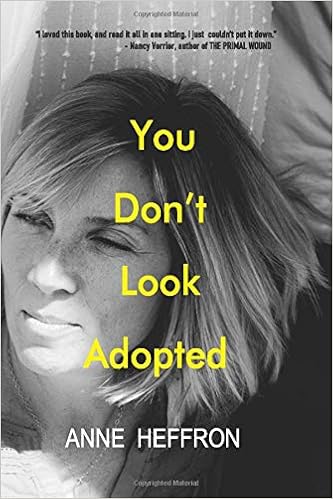
- You Don't Look Adopted
Autobiography/Memoir You Don't Look Adopted Anne Heffron 2016 Writing this memoir of being adopted was crucial for Anne Heffron; she felt she needed to tell this story in order to save her life. Adopted as a baby, Heffron describes the deep fear that, in the end, everyone will abandon her, just as her mother did. External Website
- Academic Articles, L
Authors L A New Stolen Generation? ➝ Contemplating Fictional and Nonfictional Orphan Stories (2004) ➝ Conceptualizing Stigma ➝ Back to Top
- Biography of Care Experienced People, M
Authors M Raven Mother ➝ My Place ➝ Eleanor ➝ Sheila ➝ How to Create the Perfect Wife: The True Story of One Gentleman, Two Orphans an Experiment to Create the Ideal Woman ➝ Back to Top
- Yusuf P McCormack
Artists Yusuf P McCormack Yusuf Paul McCormack (1963-2021) was an Artist, Poet, Writer/Author and Trainer, based in Rugby, Warwickshire. He took early retirement from the civil service in 2015 and wrote his first verse in November of that year. It was an epiphany moment and, consumed, Yusuf wrote solidly for the next 12 months about his childhood growing up in children's institutions. In December 2016 he began to translate his written work on to canvas, where he attempted to explore the emotions that he was unable to voice as a child. His work explores the world he experienced, felt and witnessed as a child who was illegitimate, mixed raced and rejected. Yusuf’s art was his intuitive way of working using memory and imagination as a way to develop his own style. He used his combined experiences as an artist, a child of the state, to inform those who genuinely want to improve and sustain better outcomes for those who never chose their start in life. External Website
- US Singer-songwriter
Performing Arts US Singer-songwriter Angel Olsen Angel Olson was born in 1987 in Missouri. She was in foster care shortly after her birth and adopted by her foster family when she was three years old. Angel Olsen has released five albums and has collaborated with other notable figures on the American indi rock scene. External Website
- 9 Clouds Gets to University
Autobiography/Memoir 9 Clouds Gets to University Amanda Gargula 2015 Amanda writes of her pleasure in attending university, but of the challenges to that, including being the primary care giver for her family External Website
- AUTHORS X
Writers AUTHORS X External Website
- Radio & Podcast, H
Authors H How Stephen sang himself to life ➝ Hay Festival - Dickens in the 21st century ➝ How to Tell Your Life Story: Rob Henderson ➝ Why Bond and the Beatles ruled the sixties ➝ The floating hell of prison hulks ➝ Hamilton: the man behind the musical ➝ Haiti's first and only king ➝ Historical fiction with Jodi Picoult ➝ Matthew Henson: Courageous Discoverer Despite Racism ➝ Back to Top
- Peaky Blinders
Television Shows Peaky Blinders 2013 Peaky Blinders is a British period crime drama television series created by Steven Knight. Set in Birmingham, England, it follows the exploits of the Peaky Blinders crime gang in the direct aftermath of the First World War. The fictional gang is loosely based on a real urban youth gang of the same name who were active in the city from the 1910s. Series 2 has mention of the death of a child after being migrated to Australia in the early twentieth century. Polly's two children Sally 3, Michael 5, were forcibly taken from her because of her alcoholism and mode of life. Polly said that her two children were adopted to local families. While the boy stayed with his adoptive family until he was at least 17, the girl's adoption did not work out and she left the new family. The child was then migrated to Australia. The girl died of Spring Fever shortly after she arrived. The only bit of the episode is when Tommy Shelby presents his Aunt Polly with two case files -one for each of her children - detailing all that had happened to them. It's hard enough for people to get access to files in 21st Century so this representation is unlikely. The second episode of series 3 introduces a 'charitable institution' for boys and girls which was being set up by Thomas and Grace Shelby in Birmingham in 1924. The institution is described as a cover for Thomas's dealings with the Russians. We are introduced to Father John Hughes of St Mary's Boys' Reformatory. It seems pretty clear that Father Hughes intends to abuse the children in Shelby's institution. External Website
- Vivaldi taught Venetian orphan girls – did they help write his music in return?
Blogs/Web Pages/Articles Vivaldi taught Venetian orphan girls – did they help write his music in return? Harriet Constable 2024 Harriet Constable, a journalist with a passion for uncovering stories about remarkable women, discovers a book in Palo Alto about an orphanage in Venice where Antonio Vivaldi taught. Fascinated, she learns that the Ospedale della Pietà, where girls played instruments typically reserved for men, produced some of the 18th century's greatest musicians, including Vivaldi’s favorite student, violin prodigy Anna Maria della Pietà. The author becomes obsessed with the idea that these women may have contributed to Vivaldi’s compositions, despite scholars' skepticism. Inspired by their talent and resilience, she writes a novel, The Instrumentalist, exploring their potential role in shaping Vivaldi’s famous works, including The Four Seasons. 'A chance discovery introduced me to the composer’s work with abandoned children. The more I learned, the more I wondered about the creative role they played in his music.' External Website
- Unbelievable: The shocking truth behind the hit Netflix series
Non Fiction Unbelievable: The shocking truth behind the hit Netflix series T Christian Miller 2019 The real-life investigation behind the hit Netflix series, from two Pulitzer Prize-winning journalists. She said she was raped. Police said she lied. She was made to retract the report – but the nightmare only got worse. On 11 August 2008, eighteen-year-old Marie reported that a masked man had broken into her home and raped her. Within days, police – and even those closest to Marie – became suspicious of her story. Confronted by these minor inconsistencies and doubt, Marie broke down and said her story was a lie. The police charged her with making a false report. Two years later, Colorado detective Stacy Galbraith was assigned to a case of sexual assault. It bore an eerie resemblance to a rape that had taken place months earlier in a nearby town. Joining forces with the detective on that case, Edna Hendershot, the two soon discovered they were dealing with a serial rapist. As their investigation deepened, it became clear that numerous police departments had extremely similar cases on their hands – and that Marie's story bore an eerie resemblance to the cases they were investigating. Unbelievable is a chilling tale of doubt, lies, and the hunt for justice, unveiling the disturbing reality of how sexual assault is investigated and the long history of scepticism toward its victims. External Website
- Leslie Baruch Brent
Writers Leslie Baruch Brent British immunologist, Leslie Baruch Brent (1925-2019) was a key figure in the beginning of transplant research. He was also a child refugee, one of the first children to travel from Germany to England as part of the Kindertransport rescue effort. Before he left Germany he spent 2 years in a Jewish orphanage in Berlin - his parents sent him there because he was being bullied at his local school. In England, he was in a refugee camp before being sent to Bunce Court School, a German-Jewish boarding school in Kent. Despite the separation from his family, Lothar (as he was then) was happy at the school. When he turned 18, Leslie joined the British Army. After he left the Army he went to the University of Birmingham to study zoology and began studying with biologist, Peter Medawar. The trio of Medawar, Brent and Rupert Billingham did groundbreaking work on immunological tolerance. Leslie Brent had several academic appointments, culminating in his appointment as Professor of Immunology at St Mary's Hospital Medical School, a role he carried out for 20 years. Before he retired in 1990, Brent had published something like 200 academic articles. Then in 1997 he published a book on the history of transplation and in 2009, his memoir, Sunday's Child. External Website
- Children's Homes. A History of Institutional Care for Britain's Young
Academic Books & Book Chapters Children's Homes. A History of Institutional Care for Britain's Young Peter Higginbotham 2017 Children’s Homes: A History of Institutional Care for Britain’s Young by Peter Higginbotham traces the development of residential care for children in Britain from the sixteenth century to the late twentieth century. The book examines a wide range of institutions, including orphanages, reformatories, industrial schools, training ships, and children’s homes, showing how they emerged in response to poverty, abandonment, and social concern about childhood. Higginbotham explores how these institutions were founded, funded, and run, and what everyday life was like for the children who lived in them, often highlighting the gap between charitable intentions and harsh realities. The book also charts the gradual shift away from large institutional care after the Second World War, as policy and practice moved toward fostering, adoption, and smaller, family-based forms of care. External Website
- Ayeisha McFerran - Hockey Player
Sport Ayeisha McFerran - Hockey Player Ayeisha McFerran Ayeisha McFerran is an Ireland women's field hockey international. She was a member of the Ireland team that played in the 2018 Women's Hockey World Cup final. She was also named Goalkeeper of the Tournament. McFerran was also a member of the Pegasus team that won the 2014–15 Women's Irish Hockey League. Between 2015 and 2017 she was named three times as an NFHCA All-American while playing for Louisville Cardinals. When McFerran was 14 her mother was dying and she was told she would be put into foster care. She didn’t realise that she would be separated from her siblings. She had a good experience in foster where she was able to pursue hockey, some crucial to her wellbeing and aim in life: ‘They were very understanding of my situation, what I had come from and they were just very relaxed about me coming into their home. They just really made me feel very welcome from the get-go and that's something that many foster kids, I believe, don't have.’ External Website
- Dale Wasserman
Behind the Scenes Dale Wasserman Dale Wasserman was born in Rhinelander, Wisconsin, the child of Russian immigrants Samuel Wasserman and Bertha Paykel, and was orphaned at the age of nine. He lived in a state orphanage and with an older brother in South Dakota before he "hit the rails". Wasserman wrote for theater, television and film for more than 50 years and is best known for the musical Man of La Mancha, a multiple Tony Award winner. He also wrote the stage play One Flew Over the Cuckoo’s Nest, based on Ken Kesey’s novel, which has won several Tony Awards. External Website
- Antwone Fisher
Behind the Scenes Antwone Fisher Antwone Quenton Fisher (born August 3, 1959) is an American director, screenwriter, author, and film producer. Fisher was born in prison to a single mother. His father Edward Elkins had been shot dead by a jealous girlfriend two months earlier. Antwone was placed in a foster home weeks after he was born and remained in foster care through most of his childhood. After living with a foster mother for two years, Fisher was taken away from her. He was then placed into another foster home with a family named the Picketts. He spent 14 years of his childhood with the Picketts and was abused physically, verbally, and sexually. He was then removed from the Pickett home after having a fight with his foster mother. Antwone was sent to George Junior Republic School, a discipline school for boys, from which he graduated before he joined the United States Navy. His 2001 autobiographical book Finding Fish was a New York Times Best Seller. The 2002 film Antwone Fisher was written by Fisher and directed by Denzel Washington. External Website
- The Sun Walks Down
Fiction featuring Care Experience The Sun Walks Down Fiona McFarlane 2022 The Sun Walks Down (2022) by Australian writer, Fiona McFarlane, tells the story of a colonial Flinders Rangers, South Australia community searching for – or talking about if not actively searching - a missing 6-year-old boy. The cast of characters include Aboriginal Australian trackers and servants, Muslim cameleers, German born landowners, a visiting artist from Sweden, and Anglo-Australian children, policemen and teachers. McFarlane addresses well the traumatic effect for young Denny Wallace of being separated from his family. When a couple take care of him briefly—finding him asleep near their camp one morning—he is terrified they want to steal him. External Website
- Quirke (series)
Fiction featuring Care Experience Quirke (series) John Banville 2007 The Quirke series of crime novels by Benjamin Black (pseudonym for John Banville) revolve around a pathologist named Dr Garret Quirke and is set in 1950s Dublin. Quirke was orphaned as a child. He grew up in a catholic church run industrial school in Carricklea in County Sligo, west of Dublin. The boy was later taken out of the school and adopted by the wealthy Judge Garret Griffin. He later trained to become a pathologist but in the series he does some sleuthing too. Quirke is a prickly character who often drinks too much to forget his tortuous childhood and the way he abandoned his own daughter. External Website
- The Runaway
Fiction featuring Care Experience The Runaway Martina Cole 1997 A thriller which features the character of Cathy Connor who is forced into social care where she is abused. External Website