Search Results
5829 results found with an empty search
- Academic Articles, B
Authors B "One of Us": Orphaned Selves and Legitimacy in Australian Autobiography ➝ Back to Top
- Children Without Childhood: The Emotionality of Orphaned Children and Images of Their Rescuers in Selected Works of English and Canadian Literature
Academic Articles Children Without Childhood: The Emotionality of Orphaned Children and Images of Their Rescuers in Selected Works of English and Canadian Literature Irena Avsenik Nabergoj 2017 This article deals with literary depictions of social, political, cultural and religious circumstances in which children who have lost one or both parents at birth or at a later age have found themselves. The weakest members of society, the children looked at here are exposed to dangers, exploitation and violence, but are fortunate enough to be rescued by a relative or other sympathetic person acting out of benevolence. External Website
- Ingrid Bergman
Actors Ingrid Bergman Ingrid Bergman (29 August 1915 – 29 August 1982) was a Swedish actress who starred in a variety of European and American films, television movies, and plays. She was in kinship care as a teenager. Ingrid was only 3 years old when her mother died. Justus raised his daughter for the next 9 years with the help of his sister Ellen—whom Ingrid called Mama—and, being a photographer—he also owned and ran a camera shop—took many photos and home movies of his daughter. “During her childhood” writes David Smith, “Bergman may have been the most photographed person in Sweden.” Ingrid was 12 when her father died of stomach cancer. When her father died, Ingrid was left in the care of Aunt Ellen for a few months, until her aunt’s death 9 months later. The teenager then went to live with an uncle. She won many accolades, including three Academy Awards, two Primetime Emmy Awards, a Tony Award, four Golden Globe Awards, and a BAFTA Award. In 1999, the American Film Institute ranked Bergman as the fourth-greatest female screen legend of Classic Hollywood Cinema. External Website
- Imagined Orphans: Poor Families, Child Welfare, And Contested Citizenship in London
Academic Books & Book Chapters Imagined Orphans: Poor Families, Child Welfare, And Contested Citizenship in London Lydia Murdoch 2006 With his dirty, tattered clothes and hollowed-out face, Oliver Twist is the enduring symbol of the young indigent spilling out of orphanages and haunting the streets of late-nineteenth-century London. Although poor children were often portrayed as real-life Oliver Twists—either orphaned or abandoned by unworthy parents—they in fact frequently maintained contact and were eventually reunited with their families. In Imagined Orphans, Lydia Murdoch focuses on this discrepancy between the representation and the reality of children’s experiences within welfare institutions—a discrepancy that she argues stems from conflicts over middle- and working-class notions of citizenship that arose in the 1870s and persisted until the First World War. Reformers’ efforts to depict poor children as either orphaned or endangered by abusive or “no-good” parents fed upon the poor’s increasing exclusion from the Victorian social body. Reformers used the public’s growing distrust and pitiless attitude toward poor adults to increase charity and state aid to the children.With a critical eye to social issues of the period, Murdoch urges readers to reconsider the complex situations of families living in poverty. While reformers’ motivations seem well intentioned, she shows how their methods solidified the public’s antipoor sentiment and justified a minimalist welfare state that engendered a cycle of poverty. As they worked to fashion model citizens, reformers’ efforts to protect and care for children took on an increasingly imperial cast that would continue into the twentieth century. External Website
- Academic theses, F
Authors F Abandoned Children in Literature: The Orphans in J.K. Rowling’s ➝ Back to Top
- "One of Us": Orphaned Selves and Legitimacy in Australian Autobiography
Academic Articles "One of Us": Orphaned Selves and Legitimacy in Australian Autobiography Jack Bowers 2015 One of Us": Orphaned Selves and Legitimacy in Australian Autobiography (2015) by Jack Bowers explores 4 Australian autobiographies - Robert Dessaix, A Mother's Disgrace; Sharyn Killens, The Inconvenient Child; Gordon Matthews, An Australian Son; Kate Shayler, The Long Way Home & A Tuesday Thing - where the authors have been displaced by birth families. The paper examines what Jack Bowers calls, ““orphaned” selves in which the autobiographer is both orphaned in the sense of not knowing one or both birth parents, and orphaned in the sense of being estranged from a fully formed and completed self.” External Website
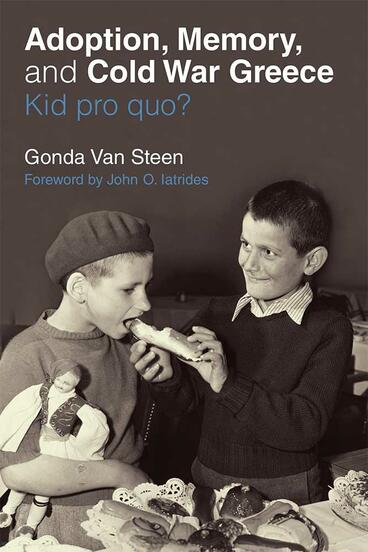
- Adoption, Memory, and Cold War Greece: Kid pro quo?
Academic Books & Book Chapters Adoption, Memory, and Cold War Greece: Kid pro quo? Gonda Van Steen 2019 More than 3000 Greek children were adopted by Americans after the Greek Civil War (1946-1949) during a 13-year period from 1950. In Adoption, Memory, and Cold War Greece: Kid pro quo? (2019), classical scholar and linguist, Gonda Van Steen, examines the circumstances precipitating these adoptions (the first large scale transnational adoption movement). She draws on a range of fields (including cultural anthropology and Greek history) to argue that anticommunism after the Greek Civil War was a significant factor in these adoptions. Gonda Van Steen uses as a case study the story of Elias Argyriadis who was executed in Athens in 1952. In 1955 authorities arranged for the adoption of his 2 daughters to an American family (the mother had died). In 2013, a son of one of the adopted girls approached Gonda Van Steen for help in finding out about his mother’s past, and thus began Van Steen’s research journey. The book also includes the testimonies of other adopted people from Greece to America and doesn’t shy away from exploring the trauma they experienced and the way they have later come together as a support network. External Website
- Blood Doesn't Define Evotypical Families: Eleanor Spence's Stories of Informal and Formal Foster Care in Australia
Academic Articles Blood Doesn't Define Evotypical Families: Eleanor Spence's Stories of Informal and Formal Foster Care in Australia Dee Michell 2021 Because of their non-normative nature, Australian foster families are not always treated “as families in their own right” according to Riggs, Delfabbro and Augoustinos (2009, p. 792, emphasis in the original). And until recently a variety of sibling bonds—between birth siblings, between biological and foster children, and between foster children in the one foster family—have, as Adam McCormick (2010) and colleagues at CREATE Foundation (2013) and the Australian Catholic University have pointed out (2014), received little attention in research. Yet the close family bonds between the blood unrelated are a central theme in The Switherby Pilgrims (1967), Jamberoo Road (1969) and The Left Overs (1982) – all written by award-winning and internationally recognised Australian children’s writer, Eleanor Spence (1928-2008). By calling on the contemporary conception of ‘evotypical’ family, in this paper, Dee Michell argues that Spence created evotypical families in these three novels and well in advance of Australian society accepting a diversity of families as the ‘norm’. External Website
- Investigating ‘care leaver’ identity: A narrative analysis of personal experience stories
Academic Articles Investigating ‘care leaver’ identity: A narrative analysis of personal experience stories Craig Evans 2019 People who spent time in public care as children are often represented as ‘care leavers’. This paper investigates how ‘care leaver’ is discursively constructed as a group identity, by analyzing 18 written personal experience stories from several charity websites by people identified or who self-identify as care leavers. Several approaches to narrative analysis are used: a clause-level analysis based on Labovʼs code scheme; the identification of turning points; an analysis of ‘identity work’; and an analysis of subject positions relative to ‘master narratives’. The findings from each of the methods are then combined to reveal how intertextual, narrative-structural, and contextual factors combine to constitute a common care leaver discourse. This forms the basis for a characterization of ‘care leaver’ group identity as ‘survivors of the system’. The findings also reveal how ‘care leaver’ as type, including stereotype, influences how identity is constructed in the personal experience narratives. External Website
- Healthy Depictions? Depicting Adoption and Adoption News Events on Broadcast News
Academic Articles Healthy Depictions? Depicting Adoption and Adoption News Events on Broadcast News Kline, Susan L.; Chatterjee, Karishma; Karel, Amanda I. 2009 Given that the public uses the media to learn about adoption as a family form, this study analyzes U.S. television news coverage of adoption between 2001 and 2005 (N = 309 stories), to identify the types of news events covered about adoption. A majority of news stories covered fraud, crime, legal disputes, and negative international adoption cases. Adoptees as defective or unhealthy were depicted more in negative news event stories, birth parents appeared less overall, and adoptive parents were most likely to have healthy depictions in positively oriented adoption experience, big family, and reunion stories. Although three quarters of the stories used primary adoption participants as news sources, one-third of the negative event stories did not contain healthy depictions of adoption participants. The authors discuss ways journalists and researchers might improve adoption news coverage. External Website
- The Role of Orphan Films in the 21st Century Archive
Academic Articles The Role of Orphan Films in the 21st Century Archive Dan Streible 2007 Well beyond the study of film history, advocates for public rights in digital culture (publicknowledge.org) have also adopted the orphan rubric, seeing it as a key to moderating the excesses of copyright and intellectual property law. NFPF's broad valorization of films "outside the scope of commercial preservation," including "documentaries, 'silent' movies, newsreels, ethnic films, avant-garde works, home movies, animation, anthropological footage, industrial films, and other independent works" (filmpreservation.org), continues to have a salutary impact for scholars as well as archivists. External Website
- Reflexivity and Lived Experience of Out-of-Home Care: Positionality as an Early Parenthood Researcher
Academic Articles Reflexivity and Lived Experience of Out-of-Home Care: Positionality as an Early Parenthood Researcher Amy Gill 2021 Amy Gill's first sole-authored publication in press, examining her positionality based as a former care leaver #cep and new mother in relation to her PhD research exploring early parenthood within the context of Out of Home Care (OOHC). External Website
- "Let's Go to the Movies": Filmic Representations of Gay Foster and Adoptive Parents
Academic Articles "Let's Go to the Movies": Filmic Representations of Gay Foster and Adoptive Parents Damien Riggs 2011 As a growing body of research evidence demonstrates, increasing numbers of gay men across the world are choosing to become foster or adoptive parents. Most important, the families that these men form are continually found to be supportive and positive environments in which to raise children. Yet despite these positive findings, other empirical evidence from examinations of popular media representations of gay parents highlights the negative assumptions that continue to be perpetuated against gay men who are parents. More specifically, these findings suggest that print and popular media promote an account of gay parents that is often either normalising or pathologising. The findings presented in this article extend this latter body of research by exploring filmic portrayals of gay men variously engaged in fostering and adoptive arrangements. External Website
- 45 Care Leaver Friendly Ways
Academic Articles 45 Care Leaver Friendly Ways Care Leavers Association 2017 The CLA has produced a short guide on how to work with adolescent looked after children and care leavers. This booklet has been created by care leavers who were involved in our health project. It is in their own words wherever possible. They share what would have made a difference to them now and when they were in care as a child. It is also punctuated by statistics on outcomes for care leavers so that you understand how growing up in care can affect an individual for their entire life. External Website
- Rewriting the Past: Gerard Mannix Flynn's Nothing to Say and James X
Academic Articles Rewriting the Past: Gerard Mannix Flynn's Nothing to Say and James X Victoria Connor 2016 In this article, Victoria O'Connor examines how Gerard Mannix Flynn, who is a survivor of trauma, is able to "translate the experience of trauma into language. Flynn does this in both Nothing to Say and James X, in which trauma is recalled but in doing so, the victim gains some agency over their own narrative. External Website
- Conceptualizing Stigma
Academic Articles Conceptualizing Stigma Bruce G Link et al. 2001 This article explores various manifestations of stigma in the young and adult life of a care leaver and the multiple trauma encountered along the path of Fouzi Mathey Kikadidi, the author. Part essay, part testimonial, this article reflects on how perceptions and stereotypes can affect a young child and explores the defense mechanisms and tools used to overcome it. It highlights different approaches to deal with stigma and invites to a joint reflection on how children in care could repossess their own history. External Website
- Academic Articles, E
Authors E Investigating ‘care leaver’ identity: A narrative analysis of personal experience stories ➝ Back to Top
- The Fosters
Television Shows The Fosters 2013 American family based drama following the lives of a lesbian couple and their 5 children - 1 biological and 4 adopted. External Website